

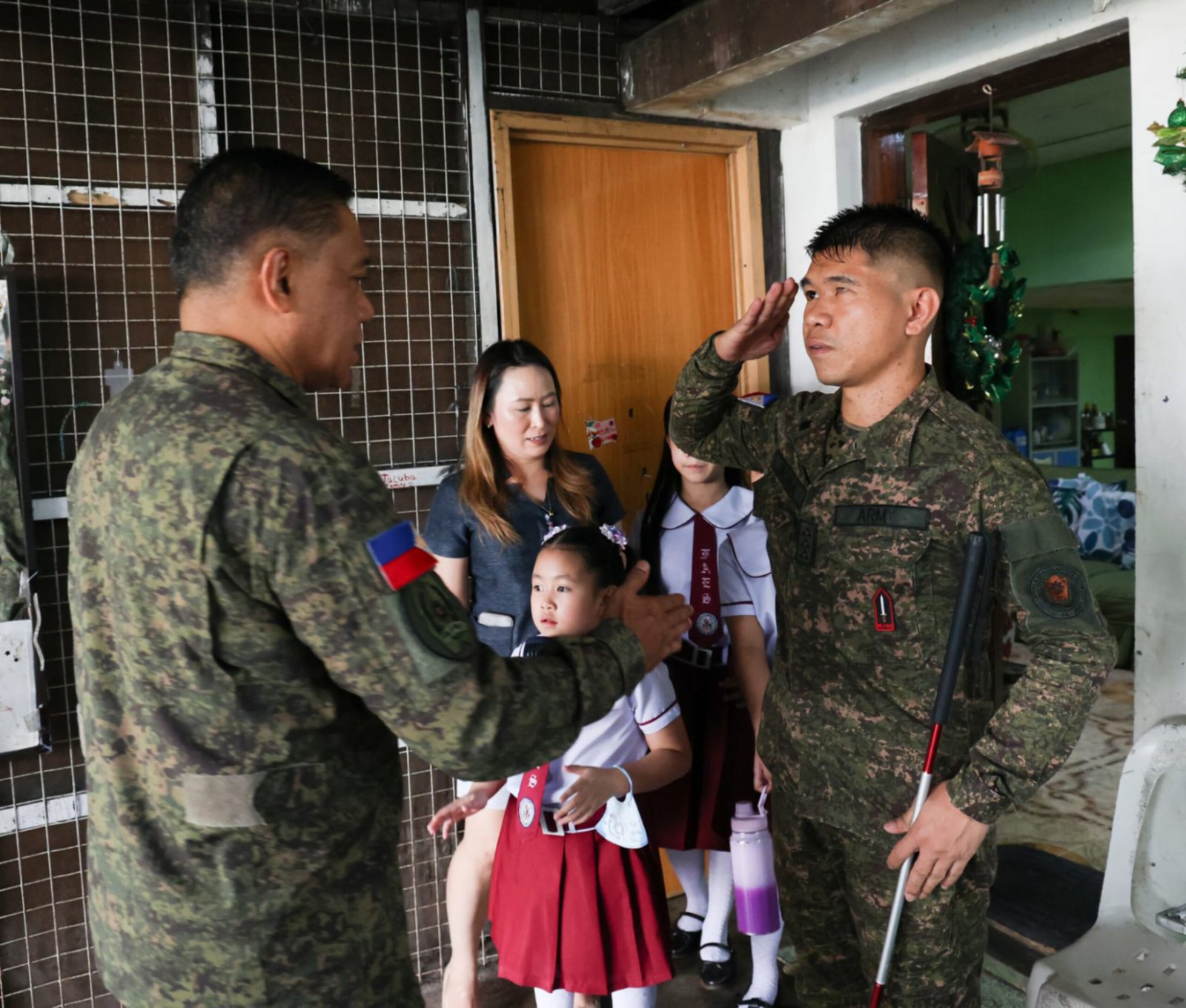
A REMARKABLE STORY OF SERVICE, PATRIOTISM, AND COUNTRY
There are men who wear the uniform, and there are men who become the uniform—its courage, its weight, its quiet promise to stand between danger and the people they swore to protect. Captain Jerome Jacuba belongs to the latter.
In 2016, in the thick dust of Datu Salibo, where the sun pressed against the earth and danger hid beneath the soil, an improvised explosive device detonated under his team’s route. In that violent instant, darkness swallowed his world. He woke to a life without sight—yet with a vision far greater than before.
Most soldiers dream of the day they remove their boots for the last time.
Captain Jacuba did not ask for his.
He was scheduled for discharge, his blindness deemed a final chapter, an ending written not by his will but by policy.
Then came a turning point no one expected.
When President Ferdinand R. Marcos Jr. learned of his case, he intervened. Not to perform charity, but to correct an injustice. A soldier who had lost his sight in service to the nation should not be made to feel unseen.
Before any official announcement, AFP Chief of Staff General Romeo S. Brawner Jr. traveled to Captain Jacuba’s home, sat with his family, and listened to the story of a man who refused to surrender to darkness. In that modest living room, surrounded by love, resilience, and unspoken fears, Gen. Brawner delivered the message that would reshape the soldier’s future.
Captain Jacuba would not be let go.
He would not be cast aside.
He would not be remembered only as a casualty of war.
Instead, the President ordered that he be promoted to Major, a recognition of fifteen years of honorable service, tactical experience, and leadership that no injury could erase. He would be assigned to adaptive duties that tap into his expertise, allowing him to continue serving the nation he nearly died defending.
Simultaneously, the AFP — in coordination with the Department of National Defense — began reviewing the Complete Disability Discharge (CDD) policy. His story became more than a personal triumph; it became the spark for institutional reform, ensuring that wounded warriors no longer face uncertainty, abandonment, or silence after their sacrifice.
In the quiet of his home, Major Jacuba stood not as a man defined by blindness, but as a soldier restored to dignity.
A father honored.
A hero embraced by the very institution he served.
For the essence of patriotism is not found in perfect bodies, but in unwavering hearts.
And Major Jerome Jacuba sees his country not with eyes, but with courage — a clarity many of us still struggle to possess.
A hero wounded.
A soldier redeemed.
A nation reminded of what true service means.
